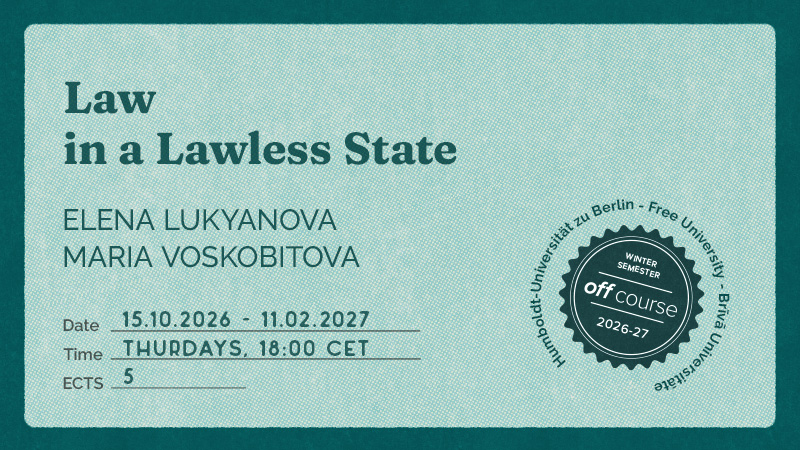
The course “Law in a Lawless State” examines the gradual transformation of law, legal institutions, and governance in contemporary Russia. It considers law through the lens of democratic backsliding, authoritarian legalism, the erosion of the rule of law, and the impact of war on legal and political institutions during the last 5 years. Through interdisciplinary analysis by leading scholars and practitioners, students will critically assess how law operates in an increasingly restrictive political environment. They will also explore what this reveal about state power, governance, and civic space in Russia today. The course focuses on recent and ongoing developments, providing participants with an evidence-based understanding of how constitutional reform, legislation, judicial institutions, human rights, electoral processes, media regulation, federalism, and criminal justice have changed in response to broader political developments.
In a period of heightened geopolitical tensions and profound shifts in European security, understanding Russia’s legal and political system is increasingly important for European audiences. Russia’s domestic developments shape regional stability, human rights conditions, international law, migration, sanctions policy, and relations between European institutions and neighboring states, making informed analysis essential for policymakers, civil society actors, legal professionals, educators, and engaged citizens alike. Combining legal, political, and socio-historical perspectives, the course is designed for participants seeking a nuanced, up-to-date understanding of the role of law in Russia’s evolving political system and of the broader implications for democracy, human rights, European security, and the international legal order.
- Teacher: Maria Voskobitova
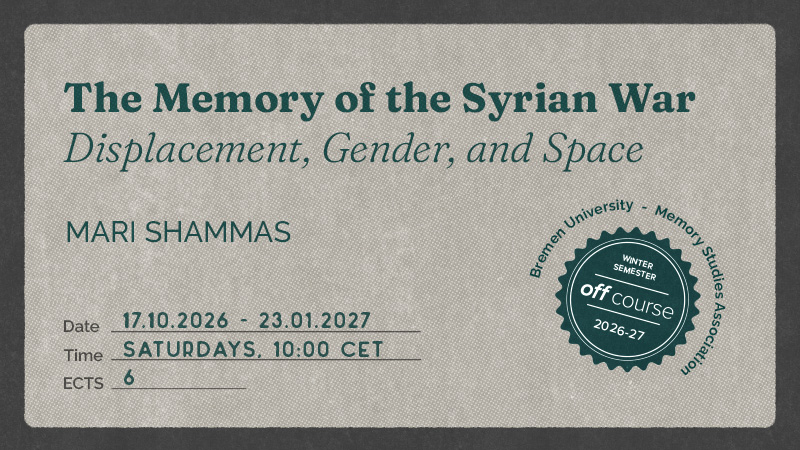
The Memory of the Syrian War is an interdisciplinary online research laboratory exploring how the Syrian war is remembered, documented, and contested across personal, spatial, cultural, and digital contexts. Integrating memory studies, oral history, heritage studies, and conflict research, it examines how displacement, destruction, and reconstruction shape collective and gendered memory.
The course analyzes the destruction of homes, cities, and heritage sites as violence against memory, while engaging with testimony, ruins, diaspora narratives, and grassroots documentation. Gendered experiences and marginalized voices remain central.
Through oral history and participatory spatial documentation, participants contribute to the documentation and analysis of Syrian war memory while developing advanced interdisciplinary research skills.
- Teacher: Mari Shammas
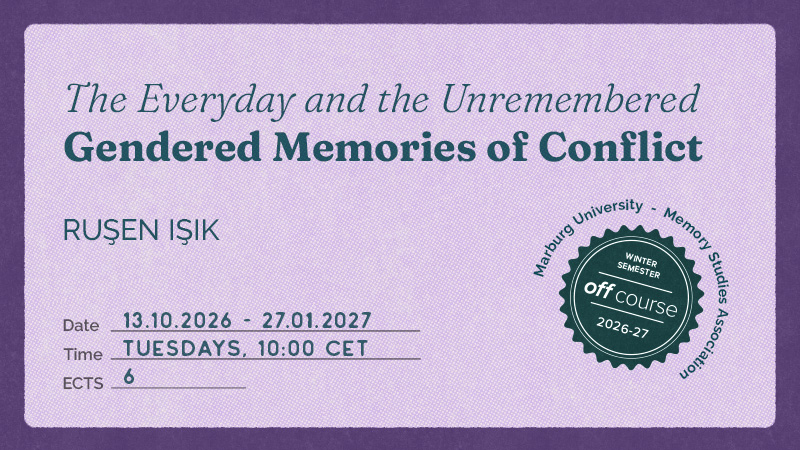
The Everyday and the Unremembered: Gendered Memories of Conflict is an online seminar that explores how armed conflict is remembered through a gendered lens. Rather than focusing on combat, heroism, or spectacular violence, the course examines everyday survival, care, waiting, disappearance, and silence as central dimensions of memory. Combining feminist memory studies, anthropology, and peace and conflict research, students will engage with theoretical texts, empirical materials, and collaborative discussion. Throughout the semester, participants will develop a Memory Lab project that applies course concepts to existing testimonies, archives, cultural artefacts, or other memory materials. The seminar emphasizes collaborative learning, ethical engagement, and critical analysis in an inclusive online environment.
- Teacher: Rusen Isik